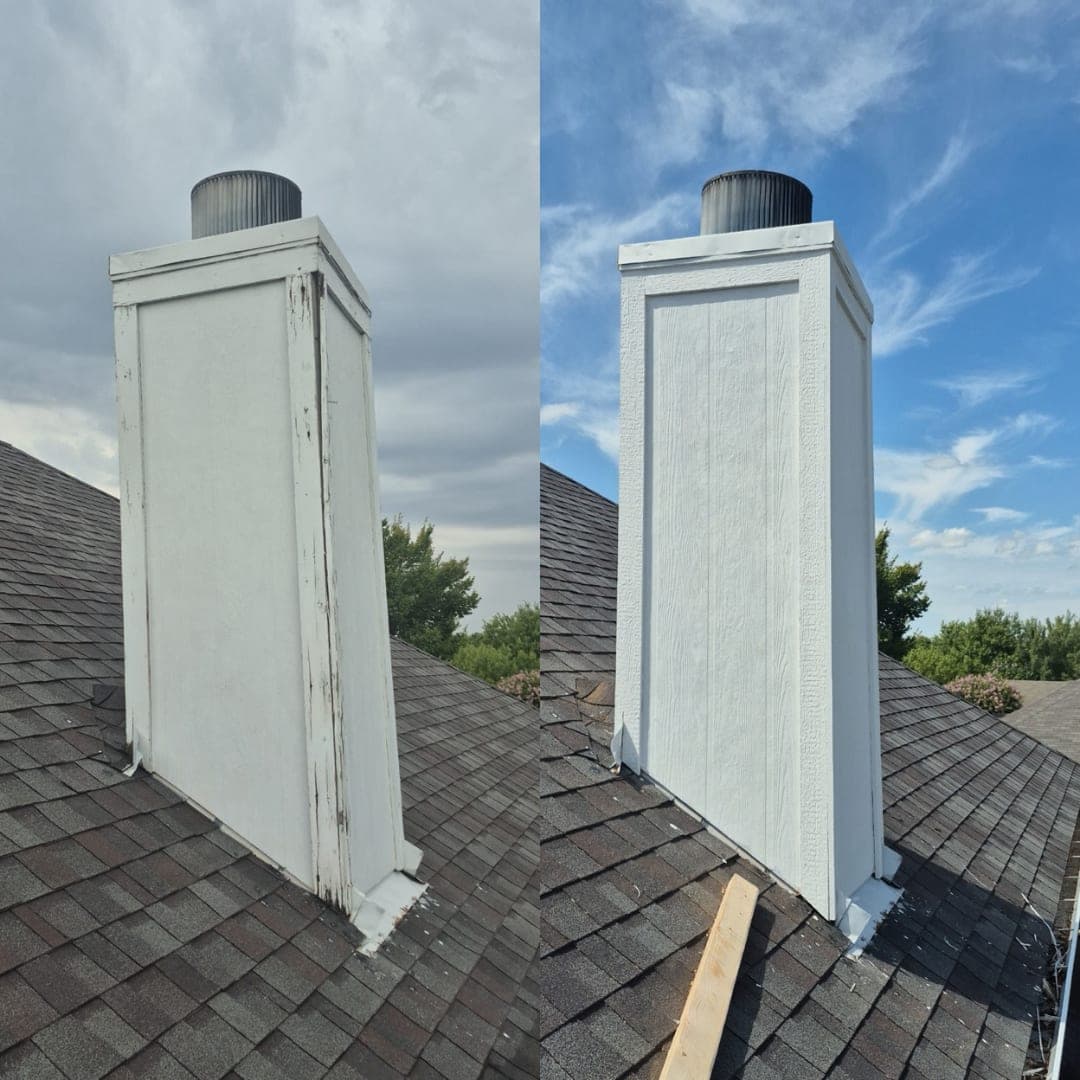
Peeling paint and failing siding on a wood framed chimney chase, and what replacement involves
 IdanNovember 2, 20265 mins
On this page
Plenty of Dallas homes do not have a brick chimney at all. What they have is a chase: a tall wood framed box built up off the roof, wrapped in siding and painted to match the house, with a metal flue running up the middle of it. From the street it reads as a chimney. Structurally it is a hollow stud wall standing out in the weather on all four sides, and that is a very different thing to maintain.
Now that burning season is opening and the first fires of the year are going in, I get a lot of calls that start with the fireplace and end up on the roof. Somebody lights a fire, smells something damp, and I go up to look. Half the time the chase siding is the story. The paint is flaking off in sheets, the corner trim boards have cupped and pulled away from each other, and the bottom edge of the siding is soft enough to push a thumb into.
Why chase siding fails faster than the rest of the house
Your walls at ground level get shade from trees, shade from the eaves, and shade from the neighbor's house. A chase sticking four or six feet above a roofline gets none of that. It takes direct Texas sun from sunrise to sunset, and in July the shingles under it are radiating heat right back up at the siding. Paint on a south or west facing chase will chalk and peel years before the paint on the same wall of the same house at the first floor.
Then the rain comes sideways. A chase has four exposed faces, four vertical corners, and a top edge where the chase cover sits. Every one of those is a seam. Once the paint film breaks, water gets into the end grain of the siding and the trim, the board swells, the caulk joint opens a little wider, and next storm it takes on more. It is the same slow cycle I described when we wrote about why crumbling mortar and cracked brick get worse every winter, just happening in wood instead of masonry, and usually faster.
What the old hardboard does
A lot of chases built in the 1980s and 1990s around Dallas were sided in pressed hardboard. It holds paint beautifully for about fifteen years and then it does not. Once moisture gets behind it, hardboard swells along the bottom edge, delaminates into layers like a wet book, and no amount of new paint sticks to it. If you are in Lake Highlands or the older parts of Preston Hollow and your chase still wears its original siding, that is almost certainly what you are looking at.
When paint is enough and when it is not
I will tell a homeowner to just repaint when the siding is still sound. Press on it. If the boards are firm everywhere, the corners are tight, and the peeling is cosmetic, scraping, priming and two coats of good exterior paint will buy you years. That is a real answer and I give it often.
Replacement becomes the honest recommendation when the material itself has given up. Soft spots, swollen bottom edges, trim boards separating at the corners, nail heads rusting through, visible gaps you can see daylight or framing through. Paint over any of that and you are sealing water inside the wall cavity instead of keeping it out. The framing behind it rots, and rotted framing around a metal flue is not just a siding problem anymore.
What a chase re-side actually involves
The first step is looking, not buying materials. A technician gets on the roof and checks the siding, the trim, the chase cover and the flashing where the chase meets the shingles. That last joint matters more than people expect, and we went into it in detail in the piece on how base flashing keeps water out where the chimney meets the roof. A proper chimney inspection tells you whether you are dealing with a surface problem or a structural one.
Tear off and framing check
Old siding and trim come off down to the sheathing. This is the part you cannot skip and cannot see from the ground. With the skin off, we can see whether the studs and sheathing are dry and solid or whether water has been sitting in a corner for five years. Any soft framing gets cut out and replaced before anything new goes on. Clearances around the flue pipe get verified while the wall is open, because that is the only time you can actually confirm them.
New skin, new trim, new seal
Then it goes back together: weather resistant barrier, new lap siding, new corner trim, all seams and penetrations caulked, and primer plus finish coats. Most of the chases we re-side now get a fiber cement or engineered wood product rather than hardboard, because it handles our sun and our humidity far better. The chase cover usually gets evaluated at the same time, since a rusted or undersized cover is often what soaked the siding in the first place. We explained the difference between the two parts in the article on what is actually sitting on top of your chimney.
Timing it right
Chase work is exterior work, and we need a few dry days with reasonable temperatures for paint to cure. Dallas gives us plenty of those in fall and winter, but not during a cold front and not during a wet week. If your chase looks rough right now, the smart move is to get eyes on it early in the season rather than in February after three storms have gone through. You can have the chimney repair work scoped and scheduled for the first clear stretch.
If the paint on your chase is peeling and you are not sure whether it needs a brush or a rebuild, the fastest way to know is to have somebody climb up and press on it. You can book a chimney chase inspection in Dallas and get a straight answer either way.
Common questions
In the Dallas area, re-siding a wood framed chimney chase typically runs somewhere in the low thousands, with most jobs landing between roughly $2,000 and $6,000 depending on chase height, how many sides are exposed, the siding material chosen, and whether rotted framing has to be cut out and rebuilt. Access matters too, since a steep or tall roof needs more staging. A simple scrape and repaint, when the siding is still sound, costs considerably less.
You can if the siding underneath is still solid. Press on the boards, especially along the bottom edge and at the corners. If everything feels firm and the only issue is flaking paint film, scraping, priming and two coats of quality exterior paint will last several years. If boards feel soft or spongy, have swollen edges, or are separating into layers, paint will seal moisture inside the wall instead of keeping it out.
A chase is a wood framed box built above the roofline, covered in siding and painted to match the house, with a metal factory built flue running up the inside. A traditional chimney is solid masonry with a clay or masonry flue. Both look similar from the street, but a chase is essentially an exterior wall standing fully exposed on four sides, so it depends on paint, caulk and flashing rather than brick and mortar for weather protection.
Common signs include peeling or blistering paint high on the chase, soft or swollen siding along the bottom edge, corner trim boards pulling apart, rust streaks running down from the chase cover, and stains on the ceiling or wall near the fireplace inside. A damp or musty smell when you first light a fire is another clue. A roof level look is the only way to confirm where the water is entering.